# Integration API (/manage/integration-api/using-the-integration-api)
> Learn how to use Pangolin's REST API to automate and script operations with fine-grained permissions
The API is REST-based and supports many operations available through the web interface. Authentication uses Bearer tokens, and you can create multiple API keys with specific permissions for different use cases.
For Pangolin Community Edition, the integration API must be enabled. Check out [the documentation](/self-host/advanced/integration-api) for how to enable the integration API.
## Authentication [#authentication]
All API requests require authentication using a Bearer token in the Authorization header:
cURL
JavaScript
Python
```bash
curl -H "Authorization: Bearer YOUR_API_KEY" \
https://api.example.com/v1/
```
```javascript
const response = await fetch('https://api.example.com/v1/endpoint', {
headers: {
'Authorization': `Bearer ${apiKey}`
}
});
```
```python
import requests
headers = {'Authorization': f'Bearer {api_key}'}
response = requests.get('https://api.example.com/v1/endpoint', headers=headers)
```
## API Key Types [#api-key-types]
Pangolin supports two types of API keys with different permission levels:
### Organization API Keys [#organization-api-keys]
Organization API keys are created by organization admins and have limited scope to perform actions only in that organization.
### Root API Keys [#root-api-keys]
Root API keys have some extra permissions and can execute operations across orgs. They are only available in the Community Edition Pangolin:
Root API keys have elevated permissions and should be used carefully. Only create them when you need server-wide access.
## Creating API Keys [#creating-api-keys]
Navigate to your admin panel:
* **Organization keys**: Organization → API Keys
* **Root keys**: Server Admin → API Keys (self-hosted only)
Click "Create API Key" and provide a descriptive name for the key.
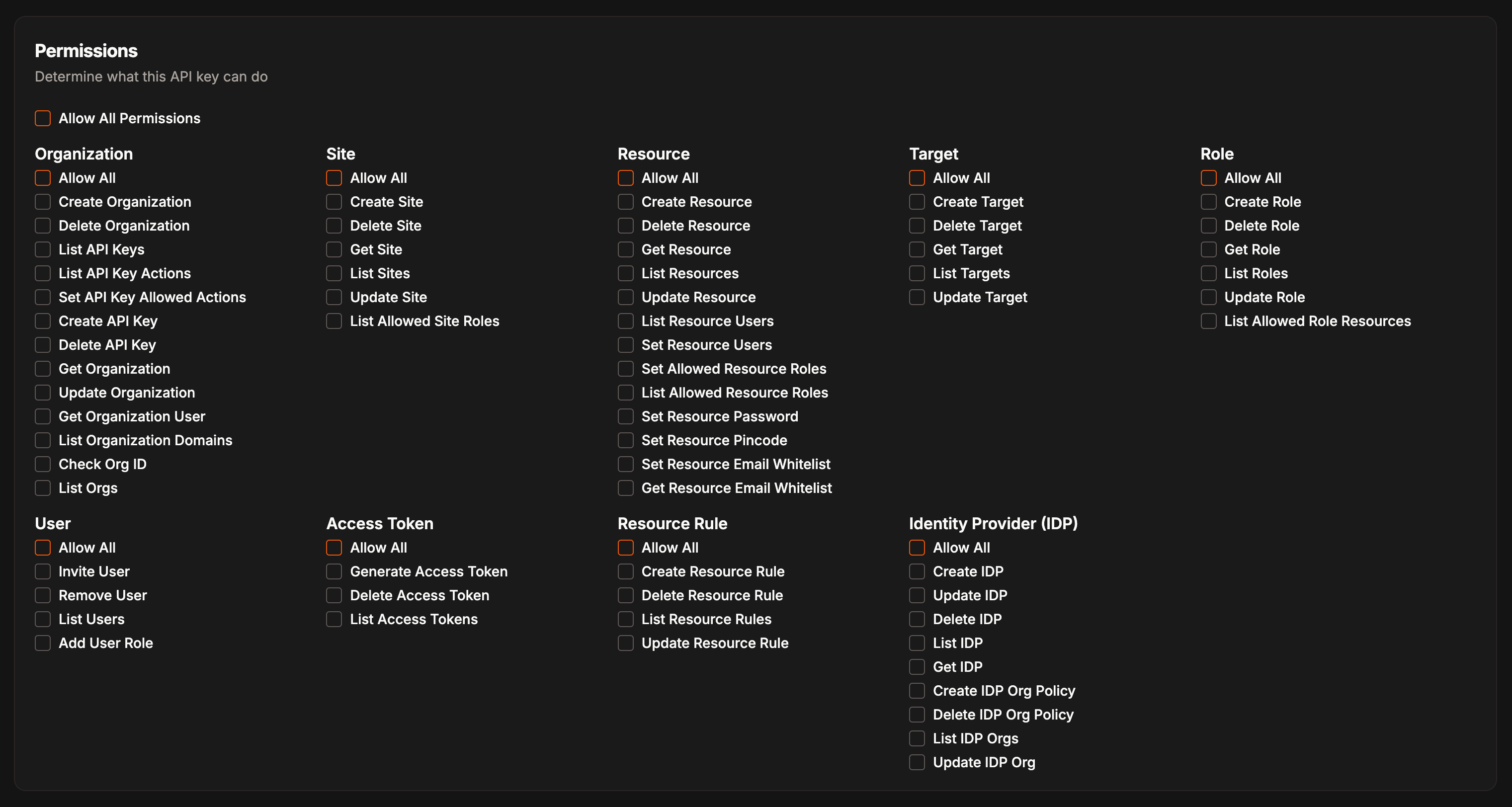
Select the specific permissions your API key needs from the permissions selector.
 Copy the generated API key immediately. It won't be shown again.
Store API keys securely and never commit them to version control. Use environment variables or secure secret management.
## API Documentation [#api-documentation]
View the Swagger docs here: [https://api.pangolin.net/v1/docs](https://api.pangolin.net/v1/docs).
Interactive API documentation is available through Swagger UI:
Copy the generated API key immediately. It won't be shown again.
Store API keys securely and never commit them to version control. Use environment variables or secure secret management.
## API Documentation [#api-documentation]
View the Swagger docs here: [https://api.pangolin.net/v1/docs](https://api.pangolin.net/v1/docs).
Interactive API documentation is available through Swagger UI:
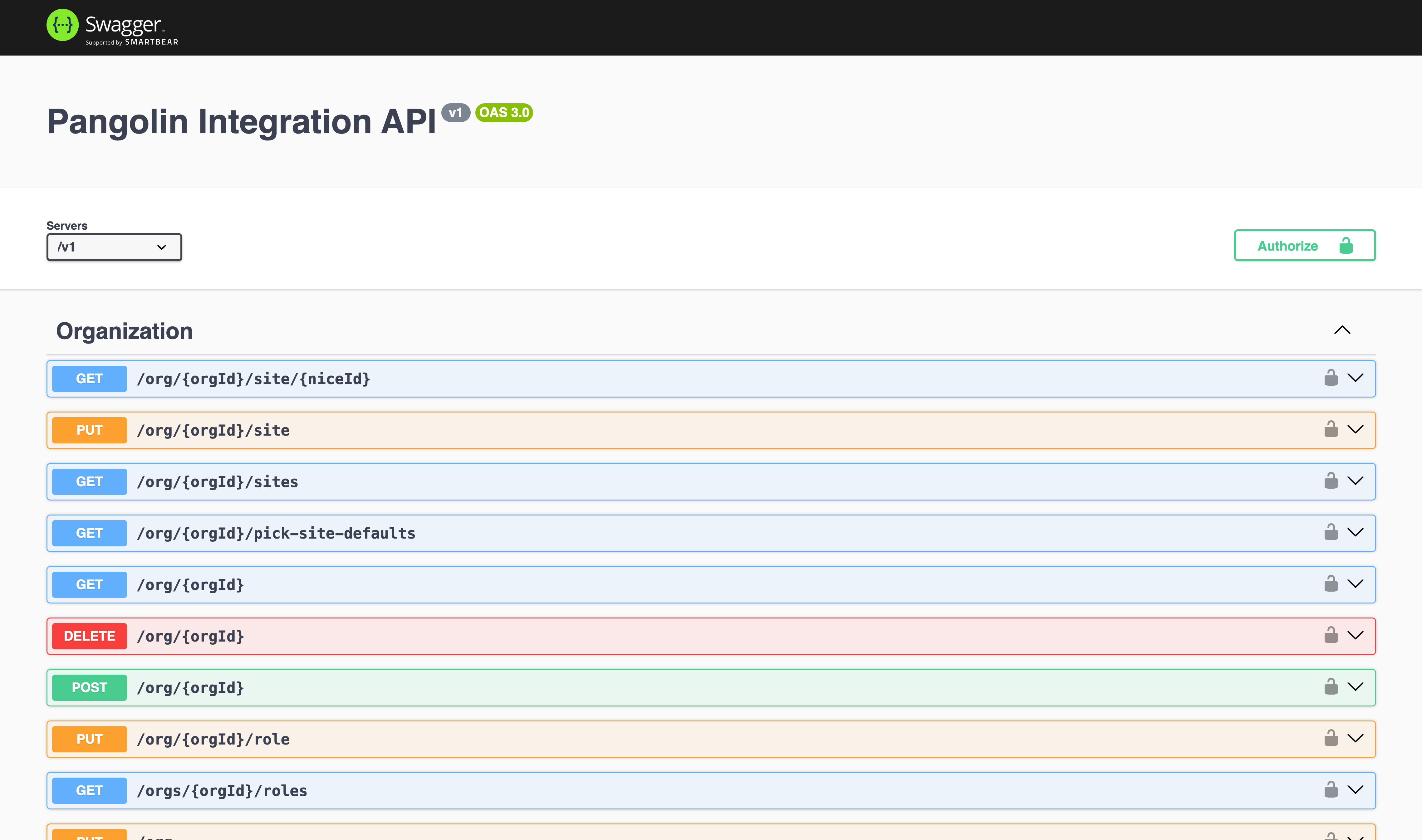 For self-hosted Pangolin, access the documentation at `https://api.your-domain.com/v1/docs`.