> ## Documentation Index
> Fetch the complete documentation index at: https://docs.pangolin.net/llms.txt
> Use this file to discover all available pages before exploring further.
# Geo-blocking
> Configure geo-blocking to restrict access based on geographic location
Geo-blocking is available in Pangolin Community Edition. It depends on Pangolin's geo-location database, which is also used by other location-aware features such as analytics. Follow [Enable Geo-location](/self-host/advanced/enable-geolocation) before creating country or region rules.
## Benefits of Geo-blocking
Geo-blocking provides several important security and compliance advantages:
### Security Benefits
* **Reduce Attack Surface**: Block access from regions with high levels of malicious activity or where you don't expect legitimate users
* **Prevent Unauthorized Access**: Limit exposure to threat actors operating from specific geographic locations
* **Compliance Requirements**: Meet regulatory requirements that restrict data access based on geographic location
* **Resource Protection**: Prevent unnecessary load on your services from regions where you don't operate
## Implementing Geo-blocking with Bypass Rules
Geo-blocking in Pangolin is implemented using [bypass rules](/manage/access-control/rules) with country-based matching. You can create rules that either allow or deny access based on the visitor's country. To apply the same geo-blocking rules to multiple public resources, define them in a [resource policy](/manage/resources/public/resource-policies) and attach that policy to each resource.
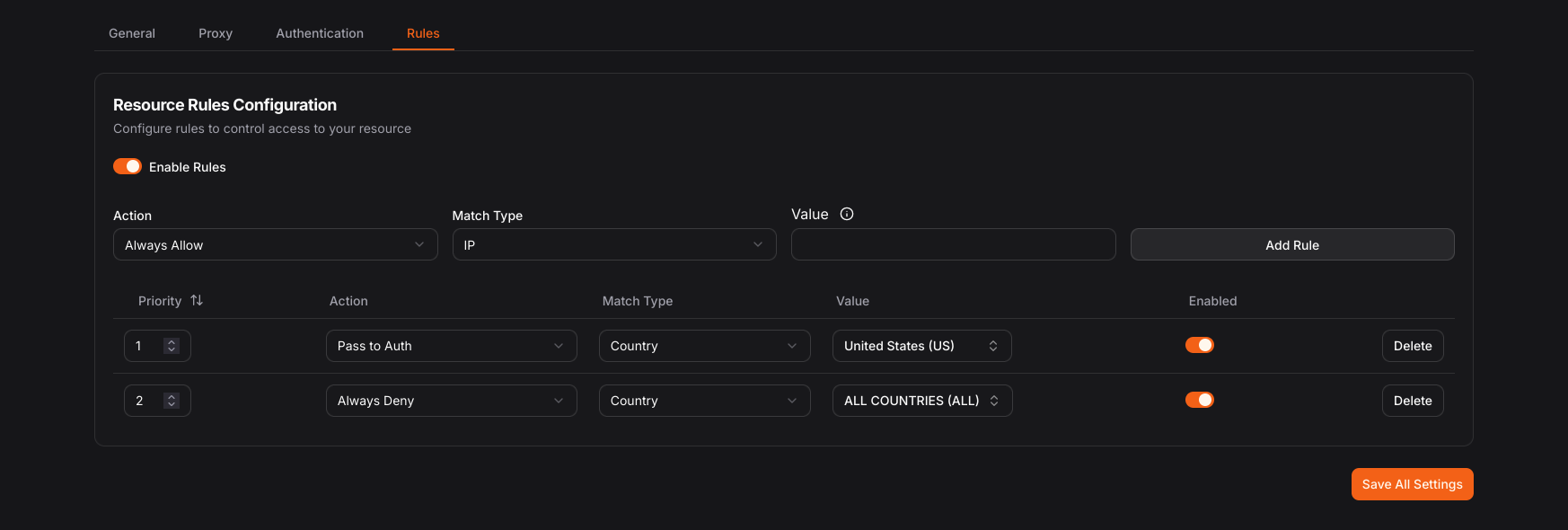 ### Setting Up Geo-blocking Rules
1. Navigate to your target resource and select the **Rules** tab
2. Create a new rule and select **Country** as the match type
3. Choose your rule action:
* **Allow**: Bypass authentication for users from specific countries
* **Deny**: Block all access from specific countries
* **Pass to Auth**: Let users from specific countries proceed to authentication
### Common Geo-blocking Patterns
#### Allow Only Specific Countries
Create a "Deny" rule that blocks all countries except those you want to allow:
1. Create a **Deny** rule
2. Select **Country** match type
3. Choose "ALL" to match all countries
4. Add priority: 100 (lower priority)
Then create specific allow rules for your approved countries:
1. Create **Allow** rules for each approved country
2. Set higher priority (e.g., 10, 20, 30) so they process first
#### Block Specific High-Risk Countries
Create targeted deny rules for specific countries while allowing all others:
1. Create **Deny** rules for each country you want to block
2. Select the specific countries from the dropdown
3. Set appropriate priorities
#### Regional Access Control
Combine geo-blocking with other rule types for sophisticated access control:
1. **Path + Country**: Block admin paths (`/admin/*`) from all countries except your headquarters
2. **IP + Country**: Allow specific IPs from restricted countries (for VPN users or partners)
3. **CIDR + Country**: Combine network-based and geography-based restrictions
### Best Practices
IP geolocation is not always 100% accurate. Users with VPNs, proxies, or mobile networks may appear to be from different countries than expected.
### Rule Priority Example
```
Priority 1: Allow - Country: United States
Priority 2: Allow - Country: Canada
Priority 3: Allow - Country: United Kingdom
Priority 4: Deny - Country: ALL
```
This configuration allows access only from the US, Canada, and UK while blocking all other countries.
### Setting Up Geo-blocking Rules
1. Navigate to your target resource and select the **Rules** tab
2. Create a new rule and select **Country** as the match type
3. Choose your rule action:
* **Allow**: Bypass authentication for users from specific countries
* **Deny**: Block all access from specific countries
* **Pass to Auth**: Let users from specific countries proceed to authentication
### Common Geo-blocking Patterns
#### Allow Only Specific Countries
Create a "Deny" rule that blocks all countries except those you want to allow:
1. Create a **Deny** rule
2. Select **Country** match type
3. Choose "ALL" to match all countries
4. Add priority: 100 (lower priority)
Then create specific allow rules for your approved countries:
1. Create **Allow** rules for each approved country
2. Set higher priority (e.g., 10, 20, 30) so they process first
#### Block Specific High-Risk Countries
Create targeted deny rules for specific countries while allowing all others:
1. Create **Deny** rules for each country you want to block
2. Select the specific countries from the dropdown
3. Set appropriate priorities
#### Regional Access Control
Combine geo-blocking with other rule types for sophisticated access control:
1. **Path + Country**: Block admin paths (`/admin/*`) from all countries except your headquarters
2. **IP + Country**: Allow specific IPs from restricted countries (for VPN users or partners)
3. **CIDR + Country**: Combine network-based and geography-based restrictions
### Best Practices
IP geolocation is not always 100% accurate. Users with VPNs, proxies, or mobile networks may appear to be from different countries than expected.
### Rule Priority Example
```
Priority 1: Allow - Country: United States
Priority 2: Allow - Country: Canada
Priority 3: Allow - Country: United Kingdom
Priority 4: Deny - Country: ALL
```
This configuration allows access only from the US, Canada, and UK while blocking all other countries.