> ## Documentation Index
> Fetch the complete documentation index at: https://docs.pangolin.net/llms.txt
> Use this file to discover all available pages before exploring further.
# OAuth2/OIDC
> Configure OpenID Connect identity provider for external authentication
Fastest way to get started with Pangolin using the hosted control plane. No credit card required.
This identity provider follows the OpenID Connect protocol. This means that it can be used to connect to any external identity provider that supports the OpenID Connect protocol such as Authentik, Keycloak, Okta, etc.
## Creating a Generic OAuth2/OIDC IdP in Pangolin
In Pangolin, go to "Identity Providers" and click "Add Identity Provider". Select the OAuth2/OIDC provider option.
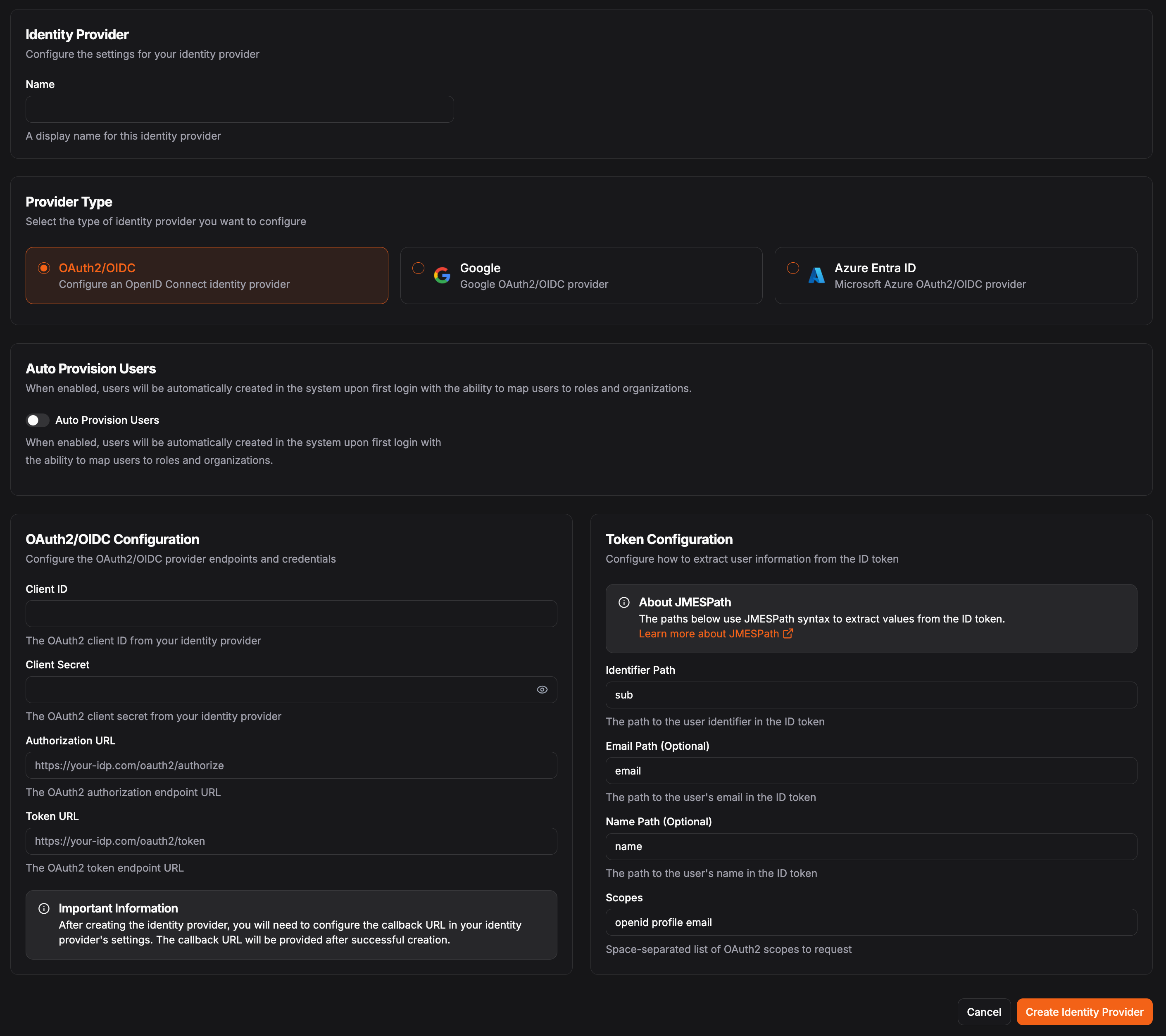 In the OAuth2/OIDC Configuration, you'll need the following fields:
The client identifier provided by your identity provider.
The client secret provided by your identity provider.
The authorization endpoint URL from your identity provider.
The token endpoint URL from your identity provider.
## Token Configuration
Use JMESPath to select attributes from the claims token. See [JMESPath](https://jmespath.org/) for more information on how to use JMESPath.
Determine how to access information from the claims token returned by the identity provider. This is used to map the user information from the identity provider to the user information in Pangolin.
This must be unique for each user within an identity provider.
**Example**: `sub` or `user_id`
Path to the user's email address in the claims token.
**Example**: `email`
Path to the user's display name in the claims token.
**Example**: `name` or `preferred_username`
The scopes to request from the identity provider (not JMESPath; must be space-delimited strings).
**Default**: `openid profile email`
Generally, `openid profile email` is sufficient for most use cases.
In the OAuth2/OIDC Configuration, you'll need the following fields:
The client identifier provided by your identity provider.
The client secret provided by your identity provider.
The authorization endpoint URL from your identity provider.
The token endpoint URL from your identity provider.
## Token Configuration
Use JMESPath to select attributes from the claims token. See [JMESPath](https://jmespath.org/) for more information on how to use JMESPath.
Determine how to access information from the claims token returned by the identity provider. This is used to map the user information from the identity provider to the user information in Pangolin.
This must be unique for each user within an identity provider.
**Example**: `sub` or `user_id`
Path to the user's email address in the claims token.
**Example**: `email`
Path to the user's display name in the claims token.
**Example**: `name` or `preferred_username`
The scopes to request from the identity provider (not JMESPath; must be space-delimited strings).
**Default**: `openid profile email`
Generally, `openid profile email` is sufficient for most use cases.