> ## Documentation Index
> Fetch the complete documentation index at: https://docs.pangolin.net/llms.txt
> Use this file to discover all available pages before exploring further.
# Install Sites
> Install Newt as a binary or Docker container
Fastest way to get started with Pangolin using the hosted control plane. No credit card required.
Newt can be installed as either a static binary executable or a Docker container. You must first create a site and copy the Newt config in Pangolin before running Newt.
## Binary Installation
### Quick Install (Recommended)
Use this command to automatically install Newt. It detects your system architecture automatically and always pulls the latest version, adding Newt to your PATH:
```bash theme={"dark"}
curl -fsSL https://static.pangolin.net/get-newt.sh | bash
```
#### Windows
To run Newt on Windows, use the latest installer from [GitHub releases](https://github.com/fosrl/newt/releases/latest).
If you are using Newt on Windows as a service or with clients, `wintun.dll` may be required.
### Manual Download
Binaries for Linux, macOS, and Windows are available in the [GitHub releases](https://github.com/fosrl/newt/releases/latest) for ARM and AMD64 (x86\_64) architectures.
Download and install manually:
```bash theme={"dark"}
wget -O newt "https://github.com/fosrl/newt/releases/download/{version}/newt_{architecture}" && chmod +x ./newt
```
Replace `{version}` with the desired version and `{architecture}` with your architecture. Check the [release notes](https://github.com/fosrl/newt/releases) for the latest information.
### Running Newt
Run Newt with the configuration from Pangolin:
```bash theme={"dark"}
newt \
--id 31frd0uzbjvp721 \
--secret h51mmlknrvrwv8s4r1i210azhumt6isgbpyavxodibx1k2d6 \
--endpoint https://app.pangolin.net
```
### Systemd Service
Create `/etc/newt/newt.env` with the initial values from your Pangolin site configuration:
```bash title="/etc/newt/newt.env" theme={"dark"}
NEWT_ID=31frd0uzbjvp721
NEWT_SECRET=h51mmlknrvrwv8s4r1i210azhumt6isgbpyavxodibx1k2d6
PANGOLIN_ENDPOINT=https://app.pangolin.net
```
Create the directory, write the file, and restrict its permissions:
```bash theme={"dark"}
sudo install -d -m 0755 /etc/newt
sudo editor /etc/newt/newt.env
sudo chmod 600 /etc/newt/newt.env
```
Then create a systemd service. Newt reads those environment variables automatically, so `ExecStart` does not need to repeat them as flags:
```ini title="/etc/systemd/system/newt.service" theme={"dark"}
[Unit]
Description=Newt
Wants=network-online.target
After=network-online.target
[Service]
Type=simple
User=root
Group=root
EnvironmentFile=/etc/newt/newt.env
ExecStart=/usr/local/bin/newt
Restart=always
RestartSec=2
UMask=0077
NoNewPrivileges=true
PrivateTmp=true
[Install]
WantedBy=multi-user.target
```
Make sure the binary exists at `/usr/local/bin/newt` before daemon reload and starting the service:
```bash theme={"dark"}
which newt
```
Reload systemd and enable the service:
```bash theme={"dark"}
sudo systemctl daemon-reload
sudo systemctl enable --now newt
sudo systemctl status newt
```
If you later change `/etc/newt/newt.env`, restart the service so Newt picks up the new values.
See [Configure Sites](/manage/sites/configure-site) for more environment variables.
## Docker Installation
### Pull the Image
Pull the latest Newt image from Docker Hub:
```bash theme={"dark"}
docker pull fosrl/newt:latest
```
### Run with Docker
Run Newt with CLI arguments from Pangolin:
```bash theme={"dark"}
docker run -it fosrl/newt --id 31frd0uzbjvp721 \
--secret h51mmlknrvrwv8s4r1i210azhumt6isgbpyavxodibx1k2d6 \
--endpoint https://app.pangolin.net
```
### Docker Compose
#### Environment Variables (Recommended)
```yaml title="docker-compose.yml" theme={"dark"}
services:
newt:
image: fosrl/newt
container_name: newt
restart: unless-stopped
environment:
- PANGOLIN_ENDPOINT=https://app.pangolin.net
- NEWT_ID=2ix2t8xk22ubpfy
- NEWT_SECRET=nnisrfsdfc7prqsp9ewo1dvtvci50j5uiqotez00dgap0ii2
```
#### Config File Injected as Compose Secret
A safer but slightly more complex way is to use [Compose Secrets](https://docs.docker.com/compose/how-tos/use-secrets/). First, create a `JSON` file containing your configuration:
```json title="newt-config.secret" theme={"dark"}
{
"id": "2ix2t8xk22ubpfy",
"secret": "nnisrfsdfc7prqsp9ewo1dvtvci50j5uiqotez00dgap0ii2",
"endpoint": "https://app.pangolin.net",
"tlsClientCert": ""
}
```
Then register and reference the secret in your `docker-compose.yml`:
```yaml title="docker-compose.yml" theme={"dark"}
services:
newt:
image: fosrl/newt
container_name: newt
restart: unless-stopped
environment:
- CONFIG_FILE=/run/secrets/newt-config
secrets:
- newt-config
secrets:
newt-config:
file: ./newt-config.secret
```
This allows you to separate sensitive secrets from plain configuration, improving security when storing or sharing your `docker-compose.yml` anywhere else.
#### CLI Arguments
```yaml title="docker-compose.yml" theme={"dark"}
services:
newt:
image: fosrl/newt
container_name: newt
restart: unless-stopped
command:
- --id 31frd0uzbjvp721
- --secret h51mmlknrvrwv8s4r1i210azhumt6isgbpyavxodibx1k2d6
- --endpoint https://app.pangolin.net
```
Start the service:
```bash theme={"dark"}
docker compose up -d
```
## Platform-Specific Installation
### Unraid
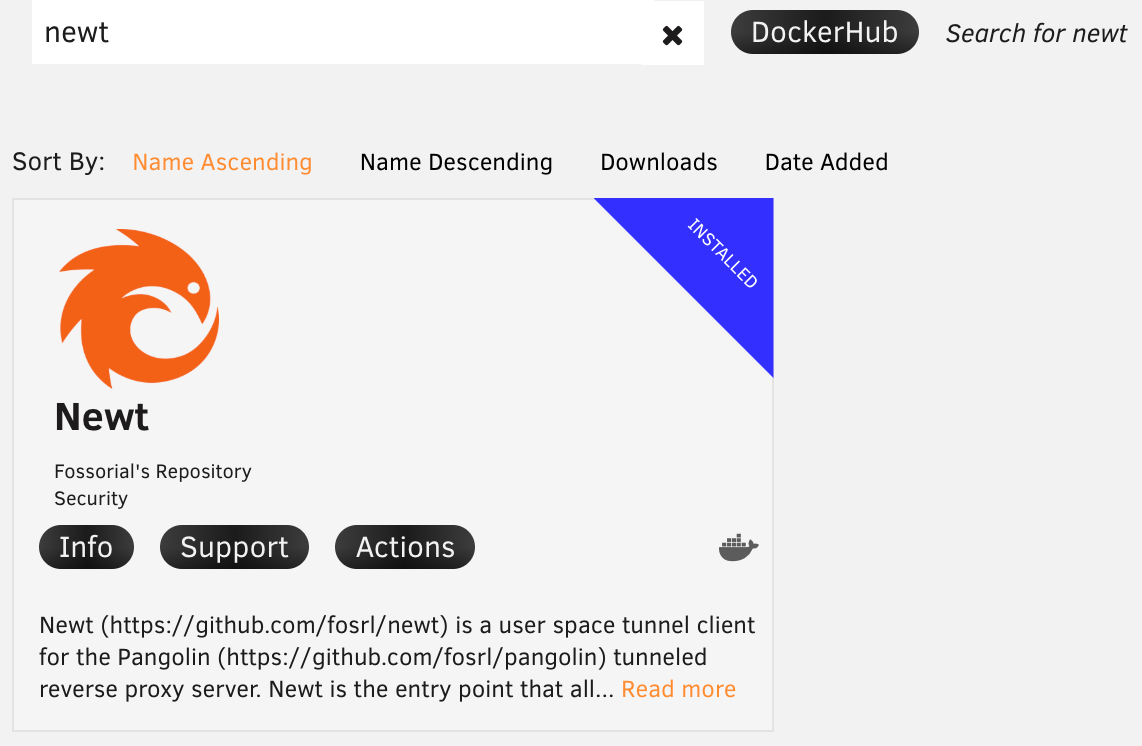
Newt is available in the Unraid Community Applications store. Search for "Newt" and follow the installation prompts. Enter the ID, secret, and endpoint from Pangolin in the template fields.
 ### Portainer and Other UIs
Container management UIs like Portainer typically allow passing commands and environment variables to containers similar to Docker Compose. Look for a commands or arguments configuration section and follow the relevant guides.
### Windows Service
On Windows, newt can to be installed and run as a Windows service to remain persistent.
#### Service Management Commands
```
# Install the service
newt.exe install
# Start the service
newt.exe start
# Stop the service
newt.exe stop
# Check service status
newt.exe status
# Remove the service
newt.exe remove
# Show help
newt.exe service-help
```
Note running the service requires credentials in `%PROGRAMDATA%\newt\newt-client\config.json`.
#### Service Configuration
When running as a service, newt will read configuration from environment variables or you can modify the service to include command-line arguments:
1. Install the service: `newt.exe install`
2. Set the credentials in `%PROGRAMDATA%\newt\newt-client\config.json`. Hint: if you run newt once with --id and --secret this file will be populated!
3. Start the service: `newt.exe start`
#### Service Logs
When running as a service, logs are written to:
* Windows Event Log (Application log, source: "newtWireguardService")
* Log files in: `%PROGRAMDATA%\newt\logs\newt.log`
You can view the Windows Event Log using Event Viewer or PowerShell:
```powershell theme={"dark"}
Get-EventLog -LogName Application -Source "newtWireguardService" -Newest 10
```
### Portainer and Other UIs
Container management UIs like Portainer typically allow passing commands and environment variables to containers similar to Docker Compose. Look for a commands or arguments configuration section and follow the relevant guides.
### Windows Service
On Windows, newt can to be installed and run as a Windows service to remain persistent.
#### Service Management Commands
```
# Install the service
newt.exe install
# Start the service
newt.exe start
# Stop the service
newt.exe stop
# Check service status
newt.exe status
# Remove the service
newt.exe remove
# Show help
newt.exe service-help
```
Note running the service requires credentials in `%PROGRAMDATA%\newt\newt-client\config.json`.
#### Service Configuration
When running as a service, newt will read configuration from environment variables or you can modify the service to include command-line arguments:
1. Install the service: `newt.exe install`
2. Set the credentials in `%PROGRAMDATA%\newt\newt-client\config.json`. Hint: if you run newt once with --id and --secret this file will be populated!
3. Start the service: `newt.exe start`
#### Service Logs
When running as a service, logs are written to:
* Windows Event Log (Application log, source: "newtWireguardService")
* Log files in: `%PROGRAMDATA%\newt\logs\newt.log`
You can view the Windows Event Log using Event Viewer or PowerShell:
```powershell theme={"dark"}
Get-EventLog -LogName Application -Source "newtWireguardService" -Newest 10
```