

Cloudflare Proxy
Pangolin works with Cloudflare proxy (orange cloud) enabled, but requires specific configuration:
Terms of Service: Enabling Cloudflare proxy binds you to Cloudflare's terms of service as traffic routes through their network.
SSL Configuration
Recommended setup:
- Use wildcard certificates with DNS-01 challenge
- Set SSL/TLS mode to Full (Strict)
- Disable port 80 (not needed with wildcard certs)
Pangolin will not work with Cloudflare's Full or Automatic SSL/TLS modes. Only Full (Strict) mode is supported.
WireGuard Configuration
Since Cloudflare proxy obscures the destination IP, you must explicitly set your VPS IP in the config file:
gerbil:
  base_endpoint: "YOUR_VPS_IP_ADDRESS"  # Required with Cloudflare proxy
Get your VPS IP
Find your VPS public IP address:
curl ifconfig.ioUpdate configuration
Add the IP to your config.yml:
gerbil:
  base_endpoint: "104.21.16.1"  # Replace with your actual IP
Restart services
Restart Pangolin to apply the changes:
docker-compose restartGetting the Real Client IP
Pangolin needs to know the original client IP address for features like rate limiting and logging. When Cloudflare proxy is enabled, the API server sees Cloudflare's IP instead of the real client IP.
Badger, Pangolin's middleware for Traefik, automatically handles Cloudflare proxy IP extraction. Badger versions 1.3.0 and later automatically:
- Trust Cloudflare IP ranges
- Extract the real client IP from the
CF-Connecting-IPheader - Set
X-Real-IPandX-Forwarded-Forheaders for downstream services
Automatic Configuration: Pangolin installer versions 1.14.0 and greater automatically add Badger to all Pangolin routes in Traefik. If you're using a newer installer, no manual configuration is needed.
Manual Configuration
If you're using an older installer or need to manually configure Badger, add it to your Traefik configuration. Badger must be applied to all routers that handle Pangolin traffic (API, dashboard, and WebSocket routes):
http:
  middlewares:
    badger:
      plugin:
        badger:
          disableForwardAuth: true

  routers:
    # Next.js router (handles dashboard)
    next-router:
      rule: "Host(`pangolin.example.com`) && !PathPrefix(`/api/v1`)"
      service: next-service
      entryPoints:
        - websecure
      middlewares:
        - badger
      tls:
        certResolver: letsencrypt

    # API router (handles /api/v1 paths)
    api-router:
      rule: "Host(`pangolin.example.com`) && PathPrefix(`/api/v1`)"
      service: api-service
      entryPoints:
        - websecure
      middlewares:
        - badger
      tls:
        certResolver: letsencrypt

    # WebSocket router
    ws-router:
      rule: "Host(`pangolin.example.com`)"
      service: api-service
      entryPoints:
        - websecure
      middlewares:
        - badger
      tls:
        certResolver: letsencrypt
Why Badger is needed: When disableForwardAuth: true is set, Badger extracts the real client IP from Cloudflare proxy headers without performing authentication. This is necessary because forward authentication is only needed for resources controlled by Pangolin, not for the main application routes. However, the main Pangolin containers and APIs still need the real client IP for proper rate limiting and IP tracking.
Pangolin Configuration
Set trust_proxy: 2 in your Pangolin config file. This tells Pangolin to trust the second-level proxy (Traefik is proxy 1, Cloudflare is proxy 2):
server:
  trust_proxy: 2
Update Badger: Ensure you're running Badger version 1.3.0 or later to get real IP addresses in logs for Public resources. Update Badger if you're using an older version.
After making these changes, restart both Traefik and Pangolin for the configuration to take effect.
Troubleshooting
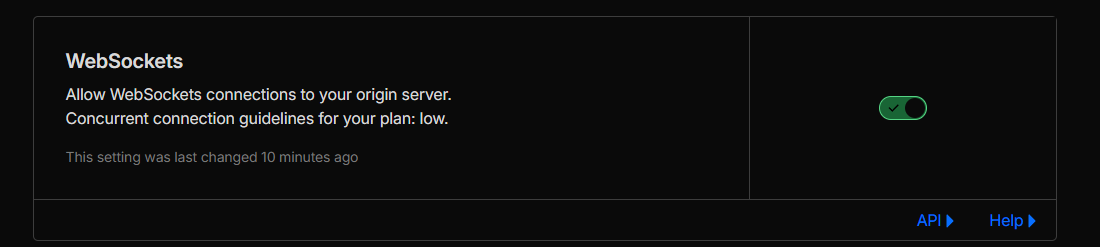
If websockets are not connecting from sites or clients, ensure that websockets are enabled in Cloudflare:
Was this page helpful?